Showing posts with label Hybrid. Show all posts
Honda Fit EV Concept 2012
Honda has unveiled the all-new Fit EV Concept electric vehicle at the 2010 Los Angeles Auto Show. Alongside the plug-in hybrid vehicle, the Fit EV Concept is integral to the Honda Electric Mobility Network as an advanced environmental approach to reducing CO2 emissions.
Powered by a high-density motor derived from the FCX Clarity fuel cell electric vehicle, The Fit EV delivers excellent efficiency with a top speed of 90 mph.
The Fit EV will achieve an estimated 100-mile driving range per charge using the US EPA LA4* city cycle (70 miles when applying EPA’s adjustment factor). Driving range can be maximized by use of an innovative 3-mode electric drive system adapted from the 2011 Honda CR-Z sport hybrid.
Battery recharging can be accomplished in less than 12 hours when using a conventional 120-volt outlet, and less than six hours when using a 240-volt outlet. When the Fit EV production model is introduced, it will be powered by a lithium-ion battery and coaxial electric motor.
The Fit EV Concept displayed at the LA Auto Show features an exclusive Deep Clear Blue Pearl exterior color and five-spoke aluminum-alloy wheels with blue inserts. Inside, an eco-friendly gray bio-fabric on the seating surfaces is outfitted.
Porsche 911 Hybrid
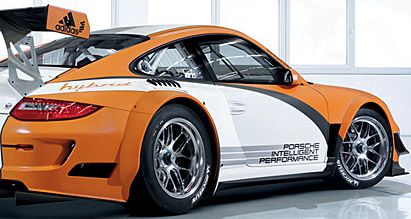
Exactly 110 years after Ferdinand Porsche developed the world’s first car with hybrid drive, the Lohner Porsche Semper Vivus, Dr. Ing. h.c. F. Porsche AG, Stuttgart, is once again taking up this visionary drive concept in production-based GT racing: During the Geneva Motor Show, a Porsche 911 GT3 R with innovative hybrid drive is making its debut, opening up a new chapter in the history of Porsche with more than 20,000 wins in 45 years scored by the extremely successful Porsche 911 in racing trim.
The innovative hybrid technology featured in the car has been developed especially for racing, standing out significantly in its configuration and components from conventional hybrid systems. In this case, electrical front axle drive with two electric motors developing 60 kW each supplements the 480-bhp four-litre flat-six at the rear of the 911 GT3 R Hybrid. A further significant point is that instead of the usual batteries in a hybrid road car, an electrical flywheel power generator fitted in the interior next to the driver delivers energy to the electric motors.
The flywheel generator itself is an electric motor with its rotor spinning at speeds of up to 40,000 rpm, storing energy mechanically as rotation energy. The flywheel generator is charged whenever the driver applies the brakes, with the two electric motors reversing their function on the front axle and acting themselves as generators. Then, whenever necessary, that is when accelerating out of a bend or when overtaking, the driver is able to call up extra energy from the charged flywheel generator, the flywheel being slowed down electromagnetically in the generator mode and thus supplying up to 120 kW to the two electric motors at the front from its kinetic energy. This additional power is available to the driver after each charge process for approximately 6 - 8 seconds.
Energy formerly converted – and thus wasted – into heat upon every application of the brakes, is now highly efficiently converted into additional drive power.
Depending on racing conditions, hybrid drive is used in this case not only for extra power, but also to save fuel. This again increases the efficiency and, accordingly, the performance of the 911 GT3 R Hybrid, for example by reducing the weight of the tank or making pitstops less frequent.
After its debut in Geneva the 911 GT3 R Hybrid will be tested in long-distance races on the Nürburgring. The highlight of this test programme will be the 24 Hours on the Nordschleife of Nürburgring on May 15th and 16th. The focus is not on the 911 GT3 R Hybrid winning the race, but rather serving as a spearhead in technology and a “racing laboratory” providing know-how on the subsequent use of hybrid technology in road-going sports cars.
The 911 GT3 R Hybrid is a perfect example of the Porsche Intelligent Performance philosophy, a principle to be found in every Porsche: More power on less fuel, more efficiency and lower CO2 emissions – on the track and on the road.
Posted in
Green Technology,
Hybrid,
Nurburgring,
Porsche,
Porsche 911,
Porsche 911 Hybrid
|
Leave a comment
2010 Toyota SAI Hybrid Sedan a redesign of the Lexus HS250 hybrid
2010 Toyota SAI Hybrid SedanToyota Motor Corp will be releasing a new petrol electric hybrid in Japan while the Prius will compete with Hyundai Motor Co in Korea. Toyota hopes to sell 36,000 of its new Sai hybrid sedan, Toyota’s goal being one million hybrid cars a year globally after 2010.The Sai is Toyota’s second hybrid-only car, this car is a redesign of the Lexus HS250 hybrid. The Sai is
New generation Lancer EVO becomes hybrid!

It is not excluded that new generation Mitsubishi Lancer EVO will be hybrid. Yes-yes, cult Japanese super cars can receive a hybrid power-plant – so assures the British magazine Autocar.
According to Autocar, new generation Lancer EVO will receive same about hybrid installation, as well as at concept Mitsubishi PX-MiEV which Japanese have prepared for a motor show in Tokyo. Its feature is that accumulators there can be recharged from the usual electric socket connection. Besides, thanks to powerful accumulators the car can go an order of 50 km exclusively in an electric mode that will allow to save fuel seriously.
However, experts already now speak about a lack hybrid Lancer EVO – because of accumulators the weight of the car will seriously increase that, most likely, will affect roadability. But on the other hand, thanks to electromotors the twisting moment will seriously grow. Besides, do not forget that on designers Mitsubishi now experts in marketing actively press. And the last assure that hybrid super cars will be on sale in the USA better, than petrol.
2010 Mercedes GL 350 BlueTEC SUV Preview

Highlights of the 2010 model year facelift includes the addition of more fuel-efficient engines and slightly revised styling.
Mercedes Benz has some big plans for next week’s New York Auto Show, with no less than three world debuts planned, as well as the as the U.S. debuts of the 2010 model year E-Class Sedan and Coupe.
The three world debuts include the unveiling of the all-new E63 AMG performance saloon, the production version of 2007’s ML450 Hybrid concept and the 2010 model year facelift for the GL-Class SUV.
On display will be the renamed GL350 BlueTEC diesel and GL450 petrol model, both of which will feature a restyled grille, new bumpers, wheels and new lights with LED accents.
The GL350 BlueTEC replaces the current GL350 CDI BlueEFFICIENCY and is claimed to offer 20-30% better fuel economy than the comparable petrol model.
The seven-seat SUV also boasts an impressive cruising range – up to 600 miles at highway speeds.
The interior should also receive a number of trim and specification updates, including the addition of Mercedes’ Elegance and Avantgarde trim levels.
2010 Chevrolet Volt Price Depend on Gas Price
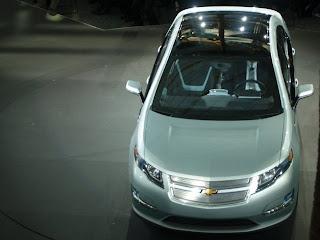
Volt price will depend on gas price, GM says.
Although the conference call was supposed to be all about the progress on designing batteries for the Chevrolet Volt, the issue of the car's price loomed large in observer's minds.
With a potential asking price that's risen from an estimated $30,000 (U.S.) to a loftier $40,000 for the compact four-seater, Bob Kruse, executive director of the program, gave no specifics on its estimated MSRP, but said the price will depend in part on the cost of gas.
"We're not wishing for higher petroleum costs, but the economic viability of what we're doing only gets greater with higher fuel prices," he said. The plan to launch the car in November, 2010, is on schedule. "$1.50 gallon gas is not helping our business case."
The average price of regular gas in the United States was actually $1.96 a gallon earlier this week, according to American government figures.
GM is not sure what the price of the Volt will be, Kruse said, nor has the company established whether it will lease the battery separately from the vehicle itself, as Nissan plans to do with its all-electric vehicle, which is to go on limited sale next year.
"Part of the price will be dependent on fuel costs at the time, which will impact the value equation the Volt provides."
The focus of the update was on the progress of the lithium-ion battery design — as GM has said, once the battery is ready, the Volt will be ready.
It is the advanced battery technology that allows the Volt to promise up to 64 km (40 miles) of electric-only driving; the small internal combustion engine works only to recharge the batteries, instead of stranding the driver, as would have occurred with GM's ill-fated EV1 all-electric vehicle at the end of its range.

"As we've seen with computers, the technology has progressed to the point where they have morphed from large desktop models, down to the size of your Blackberry," said Denise Gray, director of battery systems engineering, while confirming that design work on generations two and three of the Voltec system is happening alongside the production Volt.
"We're looking for the same types of advancements (and cost reductions) in our electronics."
In a Q&A session afterwards with various media, one astute questioner asked at what temperature those promised 64 kilometres of electric-only driving were verified. Turns out, it was the figure achieved in the normal city cycle testing, said Kruse, which is done at 20 degrees Celsius.
So if your winter commute involves regular sub-zero starts and highway driving, the question isn't whether its electric range will decrease, but by how much?

GM was obviously very sensitive about the fact that the battery cells for the first-generation Volt will come from South Korea, courtesy of LG Chem, especially when it is receiving extra money from both state and federal U.S. governments to produce environmentally advanced vehicles in and around Detroit, on top of the federal bailout money it has and will receive to keep it afloat.
The first batch of pre-production prototypes will be produced later this summer, about 80 of them, soon after the world's largest auto battery facility will open near Detroit, said GM.
Overhyped Nano on sale in India
In yet another media-frenzy-generating launch event, Tata Motor officials confirmed that orders will begin being taken in April in India for the Nano, whose super-low starting price of around $2,900 has media outlets around the world breathlessly reporting on the debut of the "world's cheapest car."
Except it's not the world's cheapest car, it's the world's cheapest new car.
Option it up with various luxuries like a right-side rear view mirror, heating and air conditioning, and a cup holder, and that price moves to 172,360 Indian rupees, according to figures available at tatanano.com, or the equivalent of $4,152.
Still, offering any new vehicle at such a low price is a remarkable achievement, even if the lack of airbags and emissions controls would not allow the Nano as is to be sold in most developed markets, and certainly not in regulation-heavy North America.

"The Nano represents the spirit of breaking conventional barriers," said Tata Motors chairman Ratan Tata. "It will provide safe, affordable, four-wheel transportation to families who till now have not been able to own a car." Or at least a new car.
The Nano offers a 35-hp. two-cylinder engine, coupled to a four-speed manual transmission, with a top speed of 105 km/h, for a published estimate of 33 seconds for the small four-seat hatchback to reach 100 km/h.
Plans are in the works to sell an upgraded version of this car to parts of Europe by 2011, the company said; it would a larger 90-hp, three-cylinder engine, available five-speed automatic, dual airbags, ABS and stability control, with a target starting price still under $5,000 (U.S.).
"Driven mainly by the change in demand that we see elsewhere in the world, we suddenly felt we had a product that could be of considerable interest as a low-cost product in western Europe, eastern Europe, the U.K. and even the U.S.," Tata told Reuters at this week's event.

Women's Car of the Year award launched
Female automotive journalists are a relative rarity in this business, but a group of 10 women auto writers from around the world will launch the first Women's Car of the Year award.
The initial group includes two journalists from Canada, as well as India, South Africa, the U.K., Australia and Europe.
"Most awards are chosen by a huge majority of men who tend to view cars differently to women," said Sandy Myhre, the New Zealand-based journalist who initiated the award.
"This award reflects changing times when you consider that today women make the final decision in as much as 85 per cent of all cars sold," according to Myhre.
After noticing that the 2007 World Car of the Year award's 43-member jury of international auto journalists did not contain one woman, Myhre helped organize a Women's COTY program in New Zealand last year, an award which went to the Volkswagen Passat BlueMotion (diesel) wagon.
"Newton-metres [or lb-ft] of torque weren't even considered, but we did look at drivability and sexiness," for those awards, as well as its carbon footprint, family friendliness, value, and, "of course," the range of colours, said Myhre.
Infiniti M to become brand's first hybrid
Playing some serious catch-up to arch-rival Lexus, Infiniti plans to start selling its own hybrid designs in North America next year, starting with its mid-size M sedans, Japan's Nikkei business daily reports.

While the Altima now offers a hybrid option, the hybrid uses leased Toyota hybrid technology, while Nissan, Japan's third-largest auto maker, struggles to come out with its own hybrid designs to rival those of Toyota and Honda.
Other luxury players are starting to jump into the hybrid market as well, with BMW and Mercedes-Benz both planning hybrid SUVs for North America and Europe this year, as well as the Mercedes-Benz S400 BlueHybrid that will compete with Lexus' top-line LS600hl.